| |
|

|
|
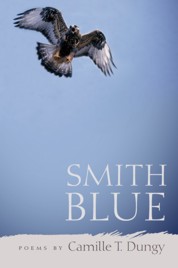
Smith Blue
Winner of the 2010 Crab Orchard Series in Poetry Open Book Prize
Southern Illinois University Press, June 2011
Smith Blue offers a survival guide for the modern heart as she takes on twenty first-century questions of love, loss, and nature. From a myriad of lenses, these poems examine the human capacity for perseverance in the wake of heartbreak; the loss of beloved heroes and landscapes; and our determination in the face of everyday struggles. The poems explore the dual nature of our presence on the planet, juxtaposing the devastation caused by human habitation with our own vulnerability to the capricious whims of our environment. In doing so, they reveal with fury and tenderness the countless ways in which we both create and are victims of catastrophe. |
This searing collection delves into the most intimate transformations wrought by our ever-shifting personal, cultural, and physical terrains, each fraught with both disillusionment and hope. In the end, the book demonstrates how we are all intertwined, regardless of race or species, living and loving as best we are able in the shadows of both man-made and natural follies.
Praise for Smith Blue
Exquisite moments of intimacy caught in the meshes of history, of human depredation
registered in language as plainspoken as it is rich in implication, Smith Blue by Camille Dungy is
a gorgeous and powerful book, one of the best I've read in recent years.
—Alan Shapiro, author
of Old War
These are large, open-hearted lyrics about love: its pleasure, its neglect, loss and
remembrance. Love here is not just parental and fraternal or of lovers and husbands,
but a love for butterflies, things and their places. With a subtle variety yet balance of line, these
are not ponderous pronouncements, but the voice of a graceful wondering about the world and
the way we carry on.
—Ed Roberson, author of City Eclogue
Loss inhabits these poems—palpable, less spiritual than common though no less devastating,
spoken by one not afraid ‘to hear what quiet really sounds like.’ And what has been lost?—lovers, landscapes, poets, none replaceable with the easy distractions of iPods or NPR. What
remains? Words. Lyrically adept yet coolly self-conscious, these poems engage loss to "recall
/ how we smelled before this end was begun."
—Michael Waters, author of Darling Vulgarity,
finalist for the Los Angeles Times Book Prize
Reviews
Molly Spencer. "One/Then one/Then two: A Review of Camille Dungy's Smith Blue." http://www.flycatcherjournal.org. January, 2013.
Jeff Charis-Carlson. "Poems resonate best when placed in conversation." www.press-citizen.com. July 15th, 2011.
Press
Hiroko Masuike. Poetry Slams slide show. The New York Times. October 7, 2011.
|
|
|
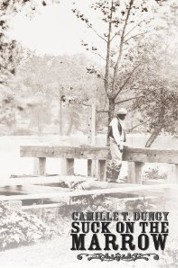
Suck on the Marrow
Red Hen Press, January 2010
Set in Virginia and Philadelphia during the mid-19th century, Suck on the Marrow traces the experiences of self-emancipated bondswomen, kidnapped Northern-born blacks, free people of color, and the slaves of a large plantation and small household. The interconnected narratives of six fictionalized characters use traceable dates, facts, and locations to investigate moving aspects of American history. These poems explore the interdependence between plantation life and life in Northern and Southern American cities, and the connections between the successes and struggles of a wide range of Americans, free and slave, black and white, Northern and Southern. |
|
Awards
Winner of the 2011 American Book Award
Winner of the 2011 Northern California Book Award in Poetry
Silver Medal Winner in Poetry at the 2011 California Book Awards
2011 NAACP Image Award Nominee
Finalist for the 2011 ForeWord Magazine Book of the Year Award, 2011 The Balcones Prize
Interview
"Small Press Spotlight: Camille T. Dungy." Interview with Rigoberto González on the National Book Critics Circle's blog Critical Mass, April 6th, 2010.
Reviews
L J Moore. "Suck on the Marrow by Camille Dungy." www.examiner.com. July 20th, 2011.
"Remembering Mine: Suck on the Marrow by Camille Dungy." www.forharriet.com. December 16th, 2010.
Tess Taylor. "Haunted History." barnesandnoblereview.com. October 4th, 2010.
James Benton. rattle.com. August 10th, 2010.
Vershawn Ashanti Young. "Make time to hear this poetry." press-citizen.com. April 15th, 2010.
More praise for the collection
Camille Dungy’s important new collection, Suck on the Marrow, explores the lives of African Americans in the 19th century, illuminating parts of slave and free black experience that are often overlooked. Plainspoken and unflinching, these poems enter the interior landscapes of the characters’ psyches to examine the nature of desire and longing and loss. With restraint and wry wit, Dungy shows us these things underscored by ownership and commodity. Foregrounding the stories of people for whom fewer records have been left, Suck on the Marrow offers us a fuller view of our collective American experience.
—Natasha Trethewey
Camille Dungy's Suck on the Marrow exhumes a troublesome history through imagery and focuses us in the modern psyche. The metaphors are so apt and concrete that we not only witness and experience slavery within an artful frame, but also with all the nerve endings exposed. This collection embraces the act of imagining acutely, whereby imagination becomes almost an action. In fact, Suck on the Marrow plots a path back to the Southern soil, to common people, back to a double-binding pathos of pain and beauty through language.
—Yusef Komunyakaa |
|
|
|
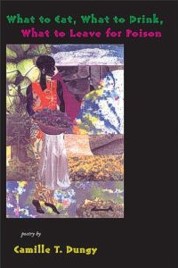
What to Eat, What to Drink, What to Leave for Poison
Red Hen Press, 2006
In each section of What to Eat, What to Drink, What to Leave for Poison, the life experiences of individual Americans (family, famous, and infamous) serve as a frame of reference for exploring 20th century American life, specifically the role of race in the development and sustenance of personal relationships and aspirations. The book’s three sections are framed by sonnets which serve as meditations on certain disappeared and disappearing aspects of the natural world, reminding us that just as with family, authority, and urban spaces, conflicted relationships with plants, animals, and open spaces are an enduring legacy of our histories. |
Awards
Finalist for the PEN Center USA 2007 Literary Award, and the Library of Virginia 2007 Literary Award
One of Small Press Distribution’s Top 25 Bestselling Books in 2006
Praise for the collection
Dungy's powerful first collection recognizes language . . . as a lifeline into the past: “Some notes/gather: the bank we map our lives around” ("Language"). For Dungy, human voices are the key: those of beloved family members, of people receding into the past, touched by segregation's injustice and/or the currents of history. In "Before My History Class," a child, preoccupied with the Bible, remarks, "When I die/I want to meet all the dead. They'll be dressed/and acting just like they did when they lived," to which her mother replies, "Someday you'll be more careful what you wish." Elsewhere, the past is generations removed, though immediate in imagination, as in "The Preachers Eat Out": a white waitress shatters the plates of the black patrons she's served, though one preacher has the last word: "Lady, my one regret/is that we don't have appetite enough/to make you break every damned plate inside this room." Dungy's ear for spoken language is near-flawless, and her subtle, resonant shifts in voice are always striking. . . .
—The Antioch Review
Camille Dungy has a garden of verses that spring up with the sunshine or hide with you in the dusk. “Cleaning” best sums up What to Eat, What to Drink, What to Leave for Poison, an amazing poetry collection, when Dungy pens “understanding clearly/what is fatal to the body./I only
understand too late/what can be fatal to the heart.” Take an ice tea and sit on the veranda or take a glass of wine and prop up in way you like your poetry, this book is a must.
—Nikki Giovanni
Award-winning African-American poet Camille T. Dungy presents What to Eat, What to Drink, What to Leave for Poison, a collection of free-verse poetry about the vagaries of life, milestone marks, and common day-to-day observations, all narrated with a down-to-earth flavor and a unique gift for succinctly shaping emotion into the briefest of stanzas. A colorful collection that both revels in the joys of life and mourns its tragedies.
—Midwest Book Review
Camille Dungy knows where she comes from. What to Eat, What to Drink, What to Leave for Poison is one of those family dinners where, hours later, everyone is still talking across the table. But, as in every family, things are complicated. Here, beneath overt sweetness, lurks covert rebellion. Which is just another way to say that these poems have both heart and irony. This is a fine first book.
—Lola Haskins, author of Desire Lines (Boa Editions)
In the title sequence of What to Eat, What to Drink, What to Leave for Poison, Camille Dungy invites her readers to “taste/what the world has to offer.” It is a tall order and the author herself leads by example and fulfills it marvelously, offering a stunning first collection that is both sweet with the richness of life and laced with the bitterness of knowledge. Through lyrics, portraits, narratives, and monologues, she explores the intricate relationship between her own family and the human family, personal history and American history, the human world and the ways humans have treated the Earth. What to Eat, What to Drink, What to Leave for Poison, is a work of sweep, breadth, and abundance--a major and magnificent book.
—Stuart Dischell, author of Dig Safe (Penguin) and Evenings and Avenues (Penguin)
| |
|